
Weekly update #141
The latest news from the fintech and VC ecosystems

Welcome to this edition of the weekly newsletter. The idea behind this is to gather all the information in the startup ecosystem in one place, with a special focus on the fintech market and the VC industry.
The latest episode of Builders was released last week! In this episode, I sit down with Eridian Alpha, product strategy lead at ETHGas . You can watch the full episode here on YouTube, or listen to it here on Spotify or here on Apple Podcast.
Eridian is the product strategy lead at ETHGas and an Ethereum builder focused on blockspace infrastructure, validator economics and the development of a real-time Ethereum network. At ETHGas, Eridian works on technology designed to transform Ethereum blockspace into a predictable and tradable commodity, supporting instant transaction settlement and applications that can shield users from volatile gas costs.
A long-standing participant in the Ethereum staking ecosystem, Eridian has operated solo validators and contributed educational resources for node operators, developers and community stakers. Eridian co-created the EthStaker Knowledge Base and maintains an extensive collection of open-source documentation covering Ethereum infrastructure, Solidity development, smart-contract security, MEV and decentralised finance.
Eridian has also built projects including High Signal, an engagement and reputation platform for Ethereum communities, and Pool Playground, an interactive tool for understanding decentralised exchange mechanics. Through technical development, education and ecosystem participation, Eridian works to make Ethereum faster, more accessible and easier to operate.
With him, we will talk about the current infrastructure behind many popular crypto projects, but about the future of the industry and the main trend in blockchain today.
Coming back to us, this week I will start sharing some interviews I made during Money20/20 in Amsterdam this year. The second one is with Ben Goldin , CEO and founder of Plumery .

Ben is a financial technology pioneer and the CEO & Founder of Plumery, a digital banking experience platform that’s revolutionising how financial institutions build and enhance mobile and web applications.
With over 20 years of experience in banking technology, Ben has held leadership roles at Mambu (CTPO, CTO) and Backbase (Chief Architect), shaping industry-defining innovations. His expertise in core banking architecture, cloud native, API-driven solutions, and digital modernisation has helped Plumery secure nearly $8 million in funding and expand across Europe, the Middle East, Africa, and Southeast Asia.
Plumery is positioning itself as a banking development platform that enables banks to modernise their digital channels without replacing their existing core banking infrastructure. In this interview, Plumery CEO Ben Goldin discusses the company’s approach, the growing role of conversational banking and why fully autonomous financial agents may remain difficult to implement.
M: Could you begin by introducing Plumery?
B: Plumery is an AI assisted digital banking development platform. A useful comparison would be Shopify for banking. We help traditional and modern financial institutions improve their customer facing experiences across mobile, web and conversational banking. Some customers also use our technology to build internal interfaces for employees.
The platform can serve as a foundation for agentic AI, although banks do not need to begin with AI. They can first modernise their digital infrastructure and introduce additional AI capabilities when they are ready. Our primary objective is to help banks build modern experiences on top of their existing core banking systems while retaining control over their own product vision. They should not have to contact Plumery every time they want to make a change.
This is why we describe Plumery as a development platform. Customers can build on top of it while using the functionality, components and accelerators that we provide.
M: Does that mean banks can use the platform to develop their own front end?
B: Correct. However, Plumery is specifically designed for digital banking rather than being a generic development platform. It includes prebuilt banking functionality through a loosely coupled architecture. Customers can decide which components they want to use and which elements they prefer to develop independently.
We sit above systems such as core banking, payments and Know YourCustomer (KYC) infrastructure. We integrate those systems and provide the functionality required for customer facing mobile and web channels. Many of these capabilities do not exist within traditional core banking systems, and they do not necessarily belong there. Banks still need them to deliver a strong digital experience.
M: What types of financial institutions use Plumery?
B: We work primarily with traditional banks, fintechs and credit unions that operate on legacy core banking infrastructure. These institutions may not be ready to replace their core systems, but they still want to provide a modern, Revolut style customer experience.
One recent customer consolidated six separate internet and mobile banking solutions into one platform powered by Plumery. Everything was launched in 8 months, when a project like that can take 24 months or more. The bank can now build distinctive mobile and web experiences without starting from the beginning, using our event driven and decoupled architecture. We provide the standard functionality, while the bank focuses its resources on the features that differentiate its business.
M: Is demand for the platform mainly being driven by AI adoption?
B: Not necessarily. AI is a natural use case that we can support, but the primary driver is the continuous modernisation of the customer experience. Consumers increasingly view their bank as another mobile application. Banks are therefore competing for user attention against other banks and against the broader digital experiences offered by technology companies.
Many banking applications developed during the past ten years no longer meet current consumer expectations. Banks need to launch better experiences and continue improving them at a much faster pace. Plumery gives them the infrastructure to do that.
M: Which trends do you expect to reshape digital banking?
B: Conversational banking and voice banking could experience a renaissance. The industry previously experimented with chatbots and integrations involving technologies such as Siri and Alexa, but the underlying technology was not sufficiently advanced. With the emergence of generative AI and large language models, conversations with computers have become significantly more natural.
This could make conversational and voice banking much more relevant. Banking services are also likely to become more personalised. Customers may eventually interact with an AI system in a similar way to speaking with a personal banker who has known them for years. The products and services offered to each customer could also be tailored much more precisely.
AI can analyse a customer’s lifestyle, transactions, cash flows, savings habits and broader financial position. This could allow banks to provide support relating to spending, financial health, wealth creation and retirement planning. Banks already possess much of this customer context. The difficulty has traditionally been interpreting it effectively. Generative AI makes that process more accessible.
M: What challenges could prevent banks from delivering this type of experience?
B: The effectiveness of generative AI depends heavily on the quality of the underlying data foundation. Customer data and context must be consolidated in a form that AI systems can understand, process and use. That is one of the areas Plumery addresses.
Banks must also consider how AI systems execute actions after interpreting the data. This is where the discussion moves towards agentic AI. I am skeptical about fully autonomous agents. If banks want predictable and deterministic outcomes, there will probably need to be a human involved.
Generative AI was not designed for determinism. It was designed to produce coherent responses, rather than consistently establish objective truth. The same system may provide different responses or decisions when presented with the same context. AI as a broader field may eventually achieve greater determinism through other technologies, but generative AI by itself is unlikely to provide it.
M: Could autonomy improve through the use of multiple agents?
B: Multiple agents could validate one another’s work, which may improve quality and reliability. However, that does not remove the fundamental limitations of generative AI. Accountability also requires traceability and a degree of predictability. It is difficult to make an agent accountable when its behaviour cannot be predicted consistently across different situations.
This is particularly important in financial services, where institutions must be able to explain decisions and establish who is responsible for them.
M: Where could AI agents still provide value to banks?
B: Agents can proactively analyse information and provide suggestions. However, even in these cases, banks cannot assume that an autonomous system has reviewed every relevant item. Consider periodic KYC checks. An AI system may generate strong results, but the bank cannot automatically assume that it has not missed an application or excluded certain information through summarisation.
As a result, the work cannot be transferred entirely to an agent. Someone may still need to verify that the system reviewed every case. AI could also support areas such as lending by analysing whether an applicant may qualify for a credit line or loan. However, I would describe this as assistance rather than autonomy.
M: How do you distinguish an autonomous agent from an AI assistant?
B: An autonomous agent should initiate and complete a process independently. It would identify when to begin, analyse the relevant data, make a prediction about the appropriate outcome and execute an action from beginning to end.
When a person manually opens a credit application and asks an AI system whether the customer should receive credit, the system is operating as an assistant or copilot. It is not acting autonomously because a human initiated the process.
M: Are traditional banks becoming more open to AI and other forms of digital innovation?
B: Traditional banks are our primary customers, but we tell them that they do not need to begin with agentic AI or generative AI. Many institutions still need to address more immediate requirements, particularly the quality of their mobile and web experiences. Once that foundation has been modernised, they should ensure that the platform can also support their current or future AI strategy.
The objective should be to create one foundation for digital banking rather than building separate platforms or point to point integrations for every new AI solution. Banks are becoming more open to experimentation, but the process remains difficult. We want to reduce that friction and enable institutions to test new AI applications without launching programmes that take an entire year.
The market is changing so rapidly that a technology selected today may no longer be relevant in twelve months. Companies such as OpenAI and Anthropic continue to modify their strategies, pricing structures and product portfolios. I expect the market to remain dynamic until approximately 2029. Banks therefore need infrastructure that supports rapid experimentation and iteration rather than tying them to a single technology.
M: Which markets are showing the strongest demand for banking modernisation?
B: The need to modernise digital channels is global. Almost any small or medium sized bank operating on legacy infrastructure is likely to require better mobile and web capabilities. This demand is not limited to one region.
When it comes specifically to AI, I have not yet encountered many traditional banks that are extremely bullish. However, we work with an AI native neobank in Southeast Asia that has a much more ambitious AI strategy.Its customers can ask an AI system to prepare a payment. The system identifies the relevant beneficiary and completes the payment details. Before the transaction is executed, it asks the customer to confirm the payment.
I would not describe this as fully agentic because the customer remains in control of the final action. It is better understood as conversational banking implemented properly.
But let's take a closer look at the main news of the last seven days. Revolut is targeting 2027 launch for its US bank, Nubank secures banking license approval in Mexico, Stripe and Advent submit a $53B offer for PayPal and Stripe enters sport partnerships with Mercedes-Benz AG Formula 1 deal. But also, Klarna faces Dutch class action, Uber acquires Delivery Hero in a $13B deal, Fourthline and Veridas merge and Kraken launches a crypto debit card in the UK and EU. In the VC market, Greylock Partners closed a $1.5B fund, Acurio Ventures a $115M fund for secondaries, Norrsken Evolve a $62M fund. But also new vehicles from CriteriaCaixa, Buenavista Equity Partners, and Soho Square Capital. And finally, some very interesting funding rounds from fintech startups like Nopan, Velocity, Flex, Float, Cyclops, Alpaca, Crypto.com, Skalar and many others.
Let’s take a closer look:
Rounds
Nopan reaches €7.2M to scale account and wallet payments across Europe
Velocity raises $38M to build stablecoin infrastructure for global enterprises
JULO secures up to $5M as it prepares for larger funding round
Float raises €4.5M to build an AI native financial platform for European tech SMEs
Tether.io leads $7M Series A in Pact Labs to bring USA₮ into payroll and payments
Cyclops raises $20M to build stablecoin infrastructure for payments companies
Bibby Financial Services secures €250M HSBC credit facility
ORA TECHNOLOGIES extends Series A to $10M
Prolo raises £4.2M to bring AI and flexible credit to construction procurement
Hadrius raises $27M to build AI native compliance infrastructure
SAIBLE raises £2.9M to tackle the UK’s £11B construction payment crisis
Lumin Digital reaches $1.6B valuation after $115M capital raise
Glacis Labs raises $6.8M to scale digital asset clearing infrastructure
Tether.io invests $20M in Ualá as Latin American fintech strategy expands
Alpaca raises $135M to expand tokenized market and AI brokerage infrastructure
Crypto.com secures $400M investment from Citadel Securities at $20B valuation
VC funds
British Business Bank adds £10M to SFC Capital partnership
CriteriaCaixa Venture arm targets €300M for Iberian deeptech fund
Greylock Partners raises $1.5B fund to back the next generation of AI native companies
British Business Bank commits €58M to Soho Square Capital Fund II
Norrsken Evolve closes €62M fund and establishes Amsterdam base
Buenavista Equity Partners secures €75M for third Spanish buyout fund
News on the market
Revolut targets 2027 launch for its US bank
Nubank Mexico secures approval to become the country’s largest digital bank
Glovo integrates Revolut Pay across seven European markets
카카오페이증권(Kakaopay Securities) secures license to enter Korea’s IPO market
Webull Securities Limited secures MiCAR approval to launch crypto services in the EU
Klarna faces Dutch class action seeking more than €500M
Stripe and Advent submit $53B joint bid for PayPal
Gemini expands beyond crypto with commission free US stock trading
Uber agrees €13B acquisition of Delivery Hero
Tabby | تابي launches cashback account as it expands beyond BNPL
Fourthline and Veridas to merge into global identity and compliance platform
Revolut named world’s best digital bank for second consecutive year
Stripe enters sports sponsorship with Mercedes-Benz AG Formula 1 deal
And here some useful resources for everyone involved in the ecosystem:
Events you don’t want to miss
Money 20/20 Middle East | Riyadh | 14-16 September (link here)
European blockchain week | Barcelona | 16-17 September (link here)
Nordic fintech week | Copenhagen | 23-24 September (link here)
Money 20/20 USA | Las Vegas | 18-21 October (link here)
Hong Kong fintech week | Hong Kong | 02-06 November (link here)
Fintech Nerdcon | San Diego | 19-20 November (link here)
You have a cool event you want to mention or to sponsor? Feel free to send me a DM.
Founders to watch in fintech
I also wanted to start shining a light on the most interesting fintech founders out there, so I thought to start sharing how I look for ideas to invest on. Every week, I will start sharing the most interesting founders in fintech, divided per area.
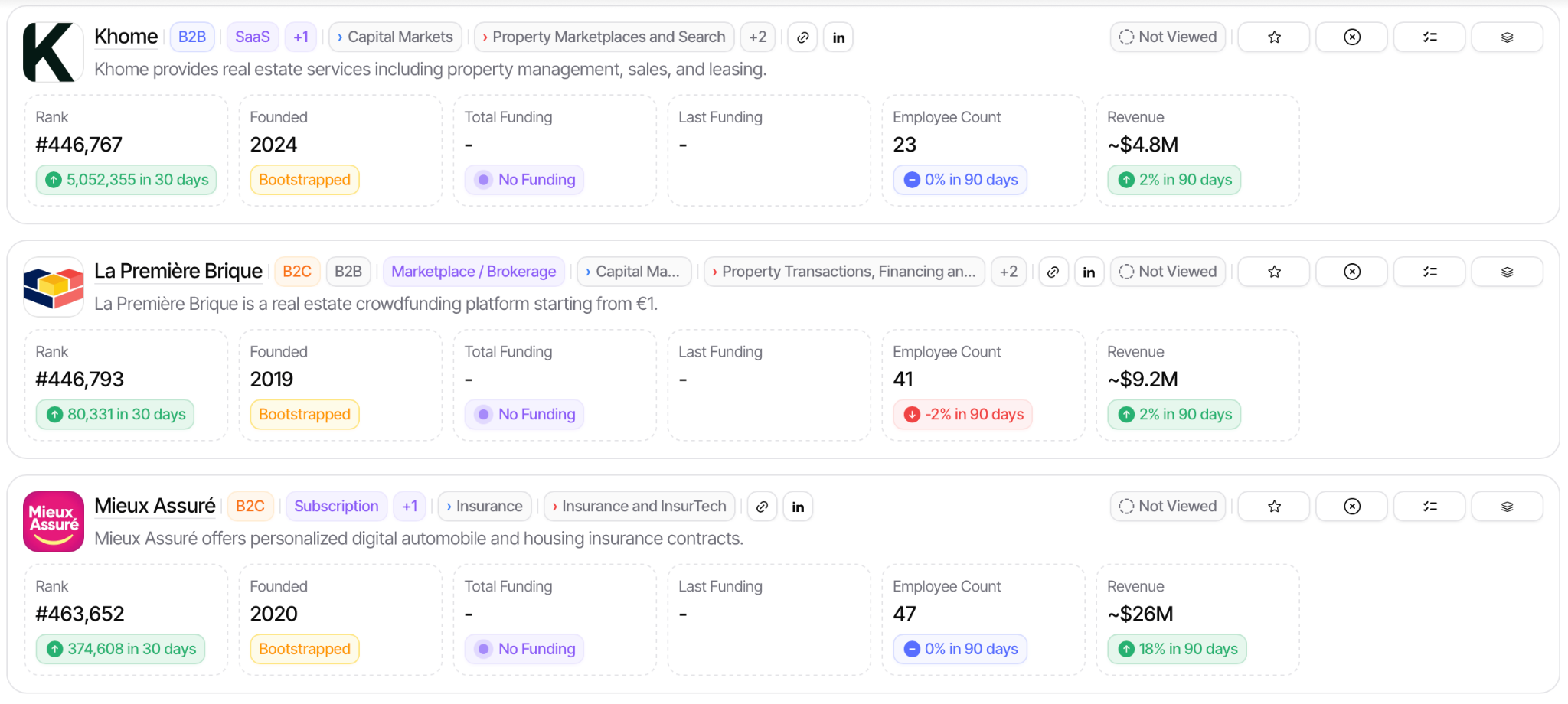
This week I took a look at most interesting fintech startups in France, focusing on companies bootstrapped in the early stage.
I usually use Spectre to scout for new ideas, the team is great and they also give me a free account once they learned I was a fan of the product. So if you wanna take a look at it, you can find it here.
VCs and PEs raising new funds now
I would like to leave this part of the newsletter as space for VC and solo GP that are launching new funds right now. I frequently speak with GPs and LPs, and I like the idea of giving them a showcase where to announce what they are doing. Here the new funds raising right now that I have been talking with:
Parallax Ventures, a fintech VC fund focused on Latam. They closed Fund I with a strong +50% IRR and 0.7x DPI, and are now raising Fund II. Take a look here if you want to know more or reach out directly to the GP at gennari@parallax.vc for details.
Founder Factor, VC focused on YC companies, that just closed investments on the latest YC W26. They are expanding the current vehicle to double down on the current batch. You can take a look here if you are interested.
RedFish Capital Partners, a private equity investor focused on Italian SMEs in growth and mature capital phases, with a track record exceeding 40% IRR and with over €200M in Assets. Currently raising its brand new AIF, which has already secured a soft commitment from the European Investment Fund (EIF). You can check them out at redfish.capital or contact the team at investor.relations@redfish.capital.
Overall, very interesting to see where the VC ecosystem is heading recently, between new emerging managers, solo GP and micro funds.
Always happy to support if I can! If you are raising a fund and you want to be listed here send me a message on Linkedin.
And finally, take also a look at the last edition of the newsletter, Weekly update #140