
Weekly update #140
The latest news from the fintech and VC ecosystems

Welcome to this edition of the weekly newsletter. The idea behind this is to gather all the information in the startup ecosystem in one place, with a special focus on the fintech market and the VC industry.
The latest episode of Builders was released last week! In this episode, I sit down with Martina Weimert, CEO and founder of EPI Company ( Wero ). You can watch the full episode here on YouTube, or listen to it here on Spotify or here on Apple Podcast.
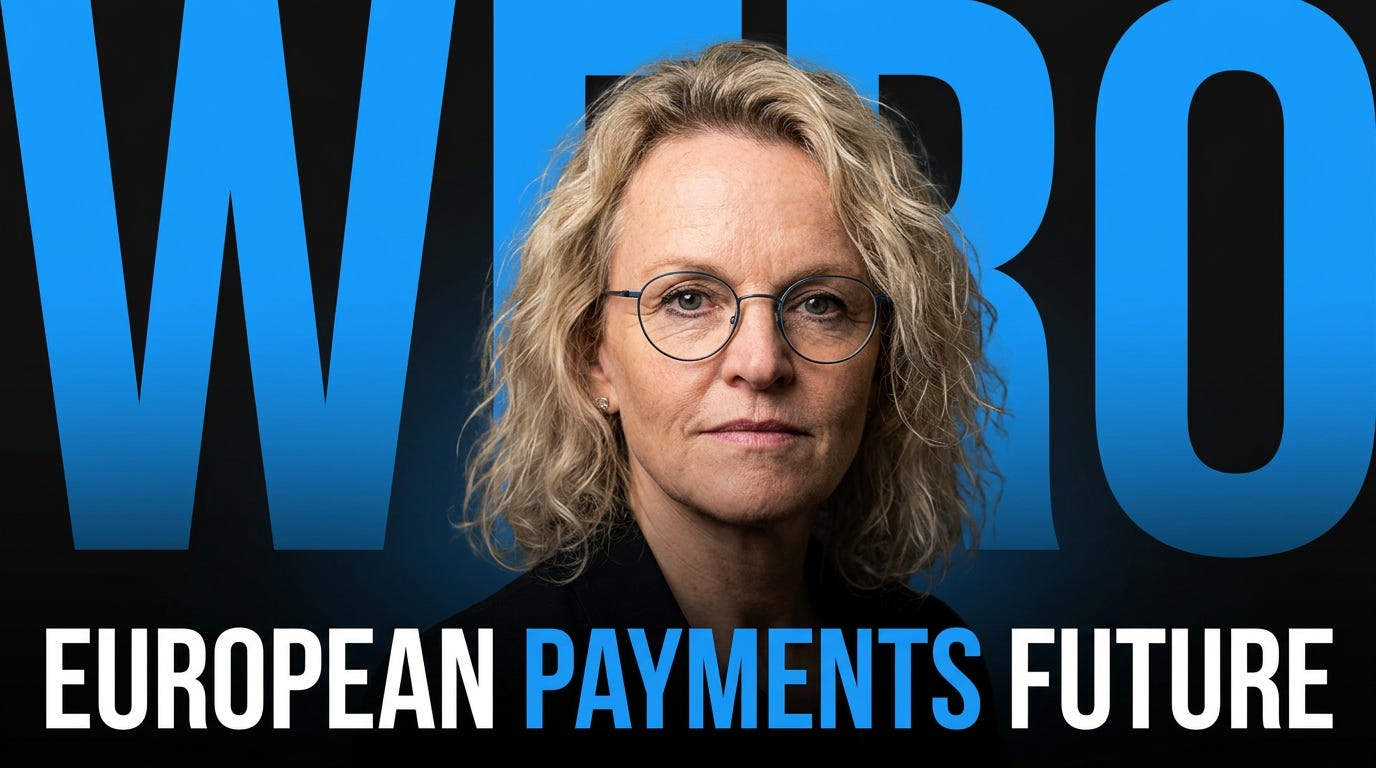
Martina has been supporting and guiding European banks and acquirers to build the foundation of the EPI company since the initiative was established in 2020, aiming to build an independent European solution and connect Europe’s payment industry.
With 20 years of experience in international payment consulting, she has in-depth experience in payments and payment solution set up, fintech, blockchain and retail banking in Europe, the Americas and Middle East. Prior to joining EPI company, she was a partner in financial services at Oliver Wyman in Paris, leading the European payment practice, and previously holding the position of Senior VP at Capgemini consulting and sales director for Deutsche Bank in France.
With her, we will talk about the importance of having an European independent and sovereign payment infrastructure, the resilience of new payment methods and the future of payments in the EU.
Coming back to us, this week I will start sharing some interviews I made during Money20/20 in Amsterdam this year. The first one, is with Luke Trayfoot , head of partnerships at YouLend .
With more than a decade in fintech, including roles at PayPal, World First and Hyperwallet, Luke specialises in embedded finance models that give SMEs fast, accessible capital through the platforms they already use.

Embedded lending is changing how small and medium-sized businesses access financing. In this interview, Luke discusses the company’s partnership model, its use of real-time cash flow data and its expansion across Europe and the United States.
M: How would you describe YouLend’s current activity in Europe?
L: YouLend operates through partnerships with payment providers, software platforms, banks and marketplaces. These partners hold significant volumes of data, which allows us to assess businesses and make lending decisions very quickly.
Our objective is to give SMEs access to capital that they may struggle to obtain through traditional channels. In many cases, a business can apply in a few clicks, receive an offer and access the funds rapidly. Banks increasingly provide liquidity through wholesale facilities, while technology companies such as YouLend manage the distribution, underwriting and servicing required to reach smaller businesses efficiently.
M: Is the availability of data the main obstacle preventing banks from approving more SME loans?
L: Data is an important part of the problem. A small business cannot always be evaluated using a static snapshot because its revenues and cash flow can change constantly.
We use real-time data to understand the current performance of the business and make faster decisions. Many large banks would like to serve this segment, but smaller loan sizes may fall outside their risk appetite or require operational capabilities that are difficult to scale internally. Our technology and partnership models help to address that gap.
M: Are traditional banks becoming more receptive to embedded lending partnerships?
L: The conversation is now very open. Different organisations bring different capabilities. Platforms provide distribution and proprietary data, banks provide liquidity and companies such as YouLend provide the technology, underwriting and servicing infrastructure.
By combining these assets, the industry can serve businesses that remain underserved by traditional lending processes.
M: Does YouLend manage the operational process, or does that remain with the bank?
L: We manage a substantial part of the operational workload. The process is designed to be digital and considerably less dependent on paperwork.
SMEs generally do not want to upload numerous documents, wait several days and then receive additional requests for information. Through our platform partnerships and the data already available, between 50% and 90% of the decision making process may already be completed before the applicant provides any additional details. We understand that speed is central to the proposition.
M: Do you also use credit bureaus and external databases?
L: Yes. Our lending is unsecured, so we analyse business revenues, cash flow and historical performance to form a forward-looking assessment.
We also conduct soft checks to confirm that the business exists, verify its identity and identify potential issues. The objective is to determine whether the company is eligible, how much funding it can responsibly receive, what the pricing should be and which repayment structure is most appropriate.
M: Which European markets are currently generating the strongest demand?
L: YouLend is active in ten markets globally, and Germany is currently one of the most interesting European opportunities. Traditional merchant cash advance products are often strongly linked to card transactions. However, as an example, a German business may generate only 30% or 40% of its revenues through cards, while the remaining 60% or 70% comes through invoices, cash or other payment methods.
Our underwriting model can assess a broader range of revenue streams, which creates access to financing for businesses that may not qualify under a card-based model. Germany also has a fragmented and highly localised banking system. A digital process can provide SMEs with faster access to competitive funding that might otherwise require weeks or even months to arrange.
M: How different are European markets from one another?
L: Europe may appear relatively uniform because many countries use the euro, but the commercial, regulatory and cultural differences are significant. We operate in Spain, where there is clear demand, although fragmented data can make it more difficult to develop a complete understanding of each customer.
We are not currently active in Italy. It is a market we would like to enter, but some structural and regulatory dynamics make fintech participation more challenging. Each market requires its own approach to data, regulation, liquidity and servicing.
M: What role does open banking play in the underwriting process?
L: Open banking allows us to analyse a much broader view of a company’s revenue and cash flow. Many embedded lending providers assess only the proprietary data available through a single platform. We can initially use that information to create a prequalified offer and then, with the business’s permission, connect through an open banking provider such as Plaid. This gives us visibility across the company’s broader financial activity and can enable us to provide a larger and more appropriate funding offer.
M: Does this mean the assessment is shifting away from traditional credit checks and towards cash flow?
L: Cash flow is central because it helps determine whether the business can realistically sustain the financing. It also supports responsible lending. Open banking data may show that a company already has several outstanding debt facilities. Even when a business is seeking additional capital, it may not fully understand the risk of becoming overextended.
Our responsibility is to assess whether the funding is appropriate, rather than simply maximising the amount offered.
M: What is the typical size of a YouLend financing facility?
L: The amount varies by business and market. We can provide funding from approximately €1,000 to several million euros. However, the weighted average is generally in the mid-five-figure range, with many facilities falling between approximately €20,000 or €50,000 and €100,000.
The objective is to provide enough capital to address a genuine business requirement, whether that involves growth, inventory, repairs or another operational need, without encouraging the company to borrow more than it can manage.
M: How do you manage defaults and portfolio risk?
L: Default performance varies, but our partnership model allows us to evaluate risk at portfolio level. We analyse expected returns, merchant pricing and portfolio performance to ensure that offers remain competitive for the business, while covering the underlying economics and risks of the financing.
The model must remain sustainable for the SME, the distribution partner, the liquidity provider and YouLend.
M: What are YouLend’s next steps for international expansion?
L: We are already active in the United States, which is a fast-growing market for us. Larger markets can be well suited to our model because we have a clearly defined segment. This includes ecommerce merchants, physical retailers and hospitality businesses seeking unsecured working capital within our target ticket sizes. We intend to enter additional markets, but our strategy is to build deep local capabilities rather than simply claim coverage. Before launching, we need the right liquidity, reliable data sources, appropriate verification providers and strong servicing infrastructure.
Customer support is particularly important. A business taking on financing may still want to speak with a person and understand exactly what it is agreeing to. We therefore keep servicing in-house rather than outsourcing it.
But let’s take a closer look at the main news of the last seven days. Satispay released its first debit card in Italy, Klarna applied for a US banking license, PayPal joined the European payment council and Revolut reshaped its leadership team in Lithuania and Southern Europe. But also, Gigs entered France with a Qonto partnership, Equifax acquired the credit bureau in Mexico, Coinbase secured a UK MiFid license and Kraken pursued a banking license in Lithuania. In the VC market, Paradigm closed a $1.2B new fund, CVC secured $3B for its latest Catalyst fund, and Expeditions $197M fund to invest in defence tech in Europe. But also new funds from Vermilion Cliffs Ventures, Primo Capital, B Capital, Climentum Capital and Magnify Ventures. And finally, some very interesting funding rounds from fintech startups like Thought Machine, Aria, Bridgement, Kord, Harmoney, Tangos, Stoa, blanco and many others.
Let’s take a closer look:
Rounds
Aria raises €7M and secures $250M invoice financing capacity
Gauntlet raises $125M from SBI Holdings USA, Inc. to scale digital asset allocation
GoTyme Bank secures $13.9M capital injection from JG Summit Holdings Inc. and Tyme Investments
Bridgement secures $20.3M to scale AI powered SMEs lending in South Africa
Harmoney raises €10M to scale AI driven compliance technology
Kord raises £6.4M series A to streamline regulated transactions
EDX Markets raises $76M to scale institutional digital asset infrastructure
Infinia raises $13.5M to bridge banking and stablecoin rails
Lissi GmbH raises €3.5M to advance Europe’s digital identity infrastructure
Young Platform raises €22.5M to expand digital asset services
Tether.io invests $20M in MB | Mercado Bitcoin’s onchain expansion
Tangos raises $20M to automate financial crime investigations
Aviva raises $18M Series A to expand lending access in Mexico
Circle Ventures invests in Flutterwave as USDC settlement expands in Africa
Klarna secures €900M German financing facility to support €5B expansion
blanco raises $5.2M to scale AI powered factoring across Latin America
Paradigm leads $5.5M seed round in M1X Global
Super.com raises $65M at $1.2B valuation
Thought Machine secures £30M from Tier 1 bank as revenue tops $100M
Binance backs Mesh in funding talks at a potential $2B valuation
eToro leads $12.5M investment in onchain derivatives platform Extended
Keyper raises $11M Series A to digitise UAE rental payments
VC funds
Vermilion Cliffs Ventures closes $25M fund II for technical founders
Paradigm raises $1.2B fund to expand beyond crypto
Expeditions closes €197M fund II for European defence technology
CVC closes €3B Catalyst III at nearly double its target
B Capital closes oversubscribed $500M Ascent Fund III
News on the market
Revolut strengthens Southern Europe and Lithuania leadership
PayPal joins European Payments Council (EPC) to help shape the future of SEPA
SumUp launches consumer banking accounts with 5% cashback at SMEs
Satispay expands into debit cards and in app investing
bunch acquires stake in Luxembourg fund services
Plumery integrates SEON fraud prevention into digital banking platform
Klarna applies for US banking license through Utah industrial bank
Crédit Agricole CIB takes full control of merchant payments venture Cawl
And here some useful resources for everyone involved in the ecosystem:
Events you don’t want to miss
Money 20/20 Middle East | Riyadh | 14-16 September (link here)
European blockchain week | Barcelona | 16-17 September (link here)
Nordic fintech week | Copenhagen | 23-24 September (link here)
Money 20/20 USA | Las Vegas | 18-21 October (link here)
Hong Kong fintech week | Hong Kong | 02-06 November (link here)
Fintech Nerdcon | San Diego | 19-20 November (link here)
You have a cool event you want to mention or to sponsor? Feel free to send me a DM.
Founders to watch in fintech
I also wanted to start shining a light on the most interesting fintech founders out there, so I thought to start sharing how I look for ideas to invest on. Every week, I will start sharing the most interesting founders in fintech, divided per area.
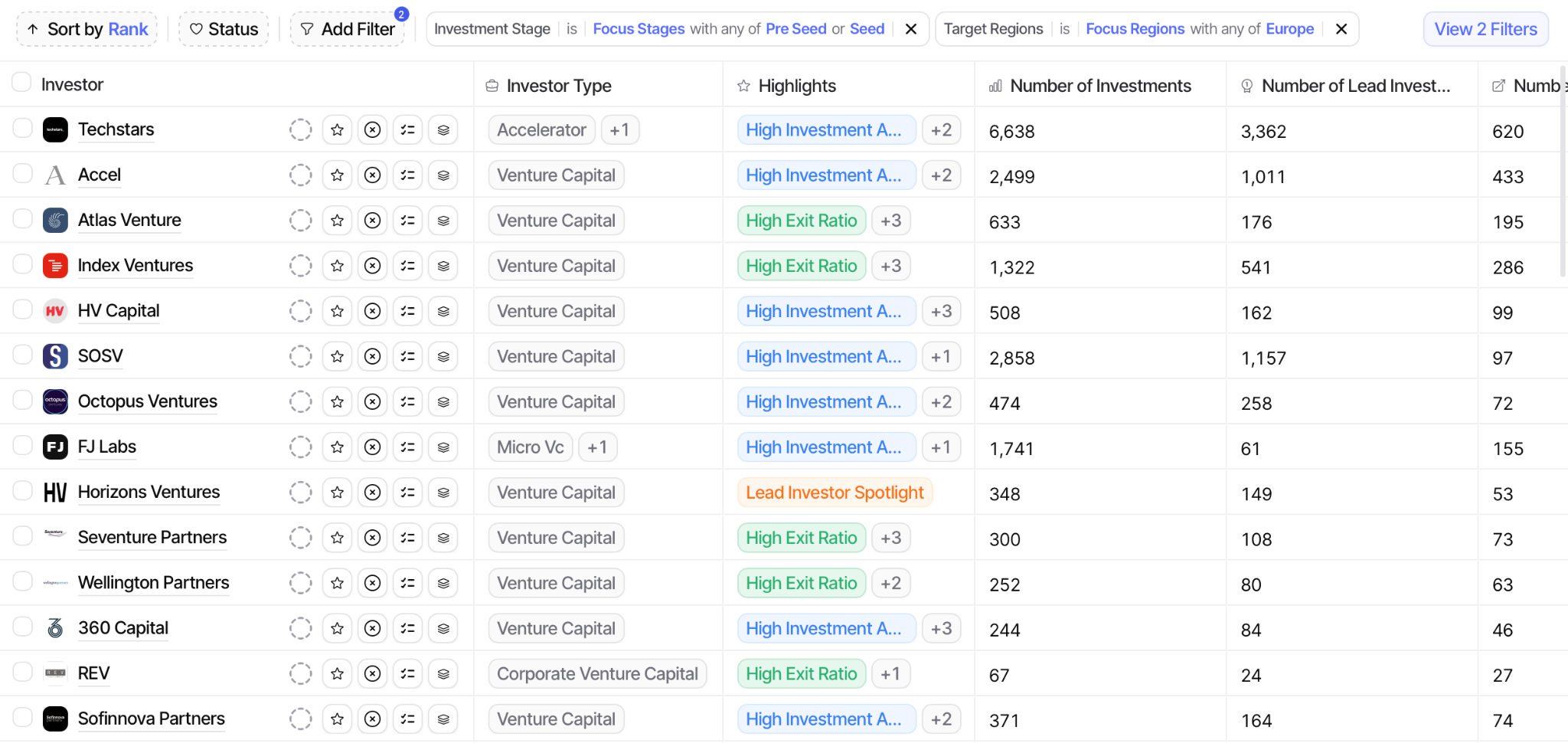
This week I am taking a different approach, and I wanted to share the list of the most active VC funds in Europe, with focus on pre-seed and seed. Lots of interesting investors in this list!
I usually use Spectre to scout for new ideas, the team is great and they also give me a free account once they learned I was a fan of the product. So if you wanna take a look at it, you can find it here.
VCs and PEs raising new funds now
I would like to leave this part of the newsletter as space for VC and solo GP that are launching new funds right now. I frequently speak with GPs and LPs, and I like the idea of giving them a showcase where to announce what they are doing. Here the new funds raising right now that I have been talking with:
Parallax Ventures, a fintech VC fund focused on Latam. They closed Fund I with a strong +50% IRR and 0.7x DPI, and are now raising Fund II. Take a look here if you want to know more or reach out directly to the GP at gennari@parallax.vc for details.
Founder Factor, VC focused on YC companies, that just closed investments on the latest YC W26. They are expanding the current vehicle to double down on the current batch. You can take a look here if you are interested.
RedFish Capital Partners, a private equity investor focused on Italian SMEs in growth and mature capital phases, with a track record exceeding 40% IRR and with over €200M in Assets. Currently raising its brand new AIF, which has already secured a soft commitment from the European Investment Fund (EIF). You can check them out at redfish.capital or contact the team at investor.relations@redfish.capital.
Overall, very interesting to see where the VC ecosystem is heading recently, between new emerging managers, solo GP and micro funds.
Always happy to support if I can! If you are raising a fund and you want to be listed here send me a message on Linkedin.
And finally, take also a look at the last edition of the newsletter, Weekly update #139