
Weekly update #123
The latest news from the fintech and VC ecosystem

Welcome to this edition of the weekly newsletter. The idea behind this is to gather all the information in the startup ecosystem in one place, with a special focus on the fintech market and the VC industry.
The latest episode of Builders has been released this week! In this episode, I sit down with Sevan Marian, founder and CEO of Fleet. You can find the full episodes here on YouTube, or here on Spotify and here on Apple Podcast. Here a short clip from the episode:
Sevan is a French technology entrepreneur and investor, currently serving as Co founder and Chief Executive Officer of Fleet, a Paris based company developing an operating system for workspace equipment management. Founded in 2019, Fleet provides an integrated platform that enables companies to lease, manage and renew IT equipment and office furniture through a subscription model. The platform combines hardware leasing, insurance, support services and device management tools, supporting more than 1,000 startups, scale ups and SMBs across Europe.
Before becoming CEO in 2025, Marian held the roles of Co founder and Chief Operating Officer and later Co CEO, leading Fleet’s operational growth and product development. Prior to Fleet, he served as Managing Director at GoMore, a European mobility platform with more than two million members across several markets, and earlier held leadership roles at Jumia Group in Morocco, where he oversaw the rapid expansion of the Jumia Market marketplace.
Alongside his entrepreneurial activity, Marian is an active technology investor with stakes in companies such as Stripe, OpenAI, Anthropic, SpaceX and Anduril Industries, as well as several early stage startups. He holds a Master in Management from EDHEC Business School.
Coming back to us, this week I’ve been reading a very interesting report, the “States of the crypto industry 2026” by Sumsub. The analysis draws on internal identity verification and user activity data from a leading full-cycle verification platform, covering pass rates, verification times, and fraud attempts across multiple regions. The report also relies on survey responses from 300+ companies across the crypto sector and synthesizes public regulatory sources capturing 2025-2026 changes in crypto‑asset rules, Travel Rule implementation, and tax reporting obligations across high‑priority regions. Here my main takeaways:
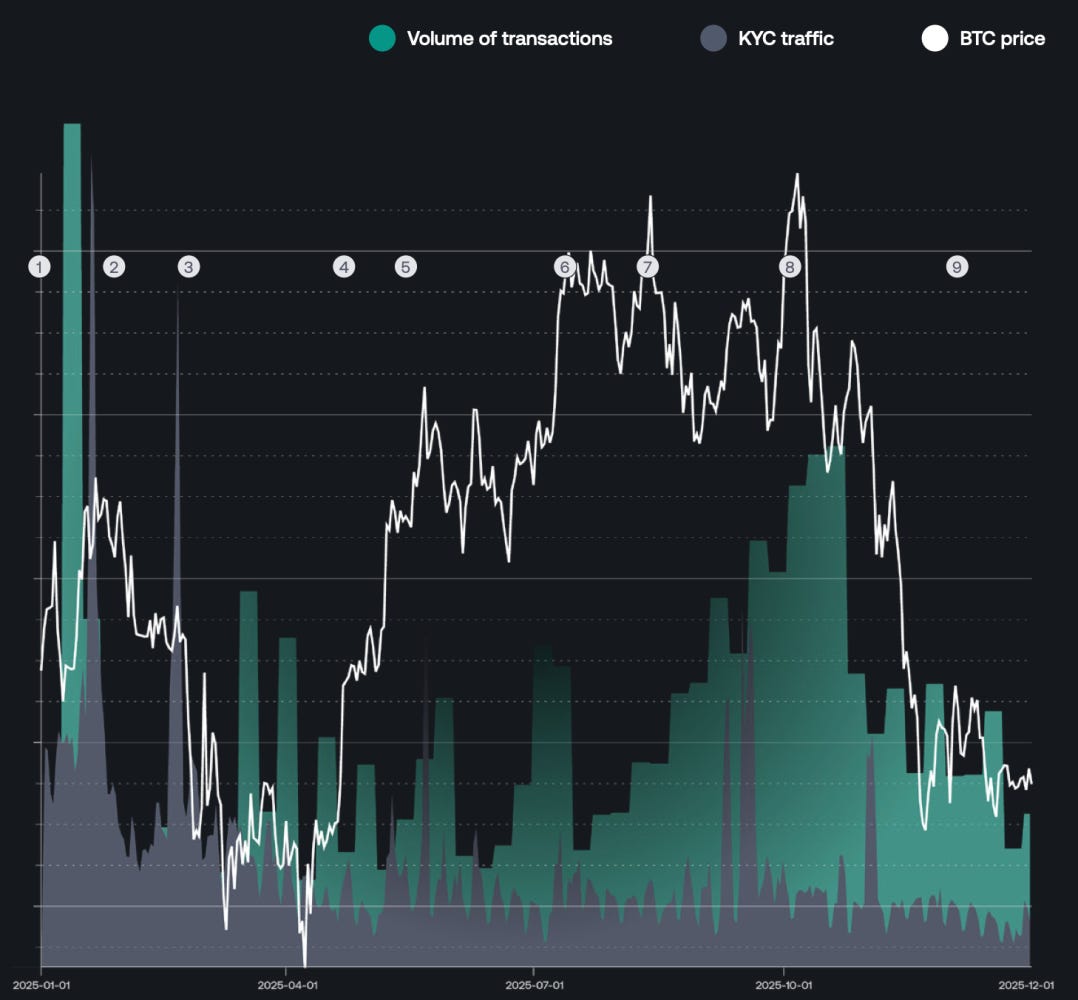
The crypto industry is moving decisively from growth driven experimentation to regulated operational maturity. In 2026, platforms increasingly compete on their ability to scale audit ready compliance and fraud prevention systems while preserving user conversion. Enforcement pressure, verification performance, and fraud resilience are now central to competitive positioning across the sector.
A growing share of operators recognize the cost of earlier shortcuts. According to recent industry data, 72 percent of respondents say they would go back five years to strengthen internal processes first, acknowledging that rapid onboarding strategies created long term risk exposure and remediation costs.
Verification priorities are also shifting. Accuracy now leads onboarding strategy, cited by 74 percent of companies as the most critical factor, compared with 39 percent prioritizing speed. At the same time, fraud threats are becoming more automated and systemic. As a result, 57 percent of platforms identify AI powered fraud detection as their main prevention priority.
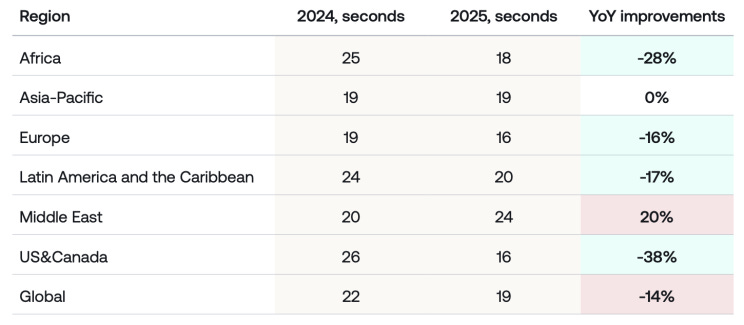
Verification performance across global regions shows that faster onboarding is possible even as regulatory requirements become stricter. In Africa, average verification time dropped from 25 seconds to 18 seconds, a 28 percent improvement. Mobile first onboarding flows designed for low bandwidth environments and diverse identification formats reduce resubmissions and manual reviews, helping bring more smartphone based users into regulated financial ecosystems.
In Asia Pacific, verification time remained stable at 19 seconds between 2024 and 2025. Platforms appear to be maintaining speed while introducing stricter compliance controls as new licensing, stablecoin, and AML frameworks expand in markets such as Singapore and Hong Kong, alongside rising threats like deepfakes and synthetic identities.
Europe improved from 19 seconds to 16 seconds, a 16 percent reduction, despite the introduction of MiCA, stronger AML frameworks, and greater Travel Rule enforcement. Latin America and the Caribbean also improved, reducing verification time from 24 seconds to 20 seconds, a 17 percent decline driven by localized onboarding flows and improved document processing across diverse regulatory environments.
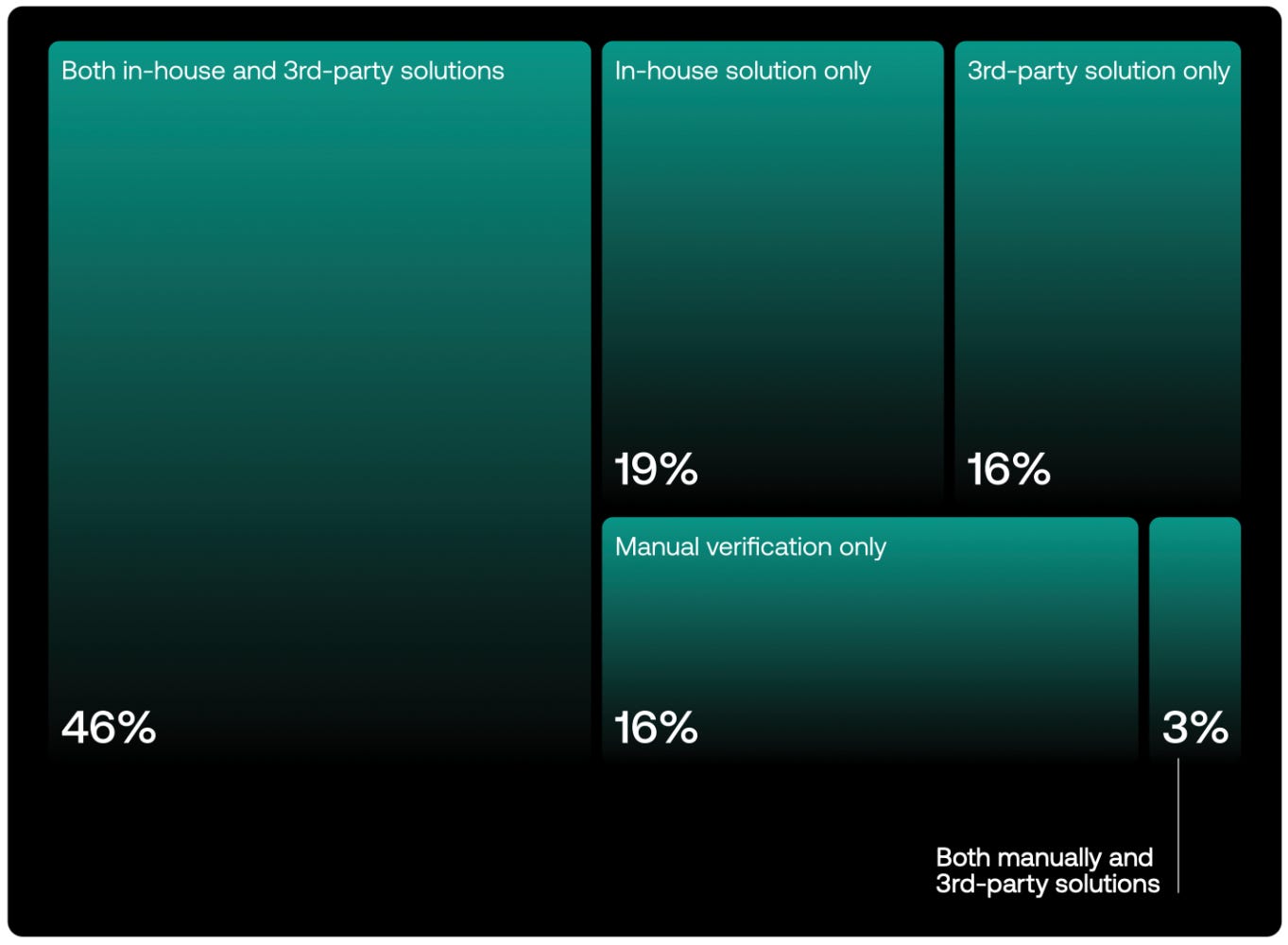
In terms of technological mix, crypto companies are increasingly adopting hybrid identity verification architectures that combine internal systems with third party solutions. According to the Sumsub Crypto Industry Research Survey 2025, 46 percent of firms now operate with this mixed model, reflecting a broader shift toward flexible, risk based verification frameworks.
In this structure, in house orchestration allows companies to maintain control over decision making and align onboarding with their internal risk matrices, which often require frequent updates as products, geographies, and threat patterns evolve. External providers, meanwhile, supply capabilities that are difficult and costly to build internally, including global document coverage, sanctions and PEP screening, and advanced biometric or liveness checks.
Fully internal systems are becoming harder to maintain as regulatory requirements expand across jurisdictions, while fully outsourced solutions can limit flexibility when platforms need tailored onboarding flows such as VIP verification, regional checks, or product specific risk policies. As a result, many vendors are introducing configurable workflow tools to adapt onboarding processes to different regulatory and operational contexts.
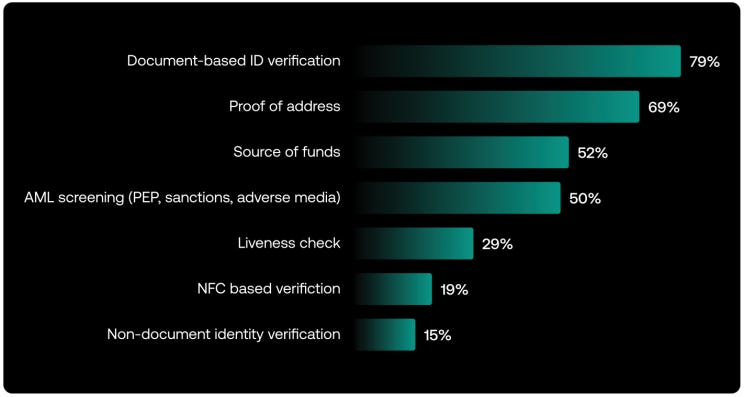
Survey data shows significant differences in the adoption of identity verification methods across crypto platforms. Document based identification remains the dominant approach, used by 79 percent of companies, while more advanced technologies such as NFC based verification are adopted by only 19 percent.
NFC verification through electronic IDs or e passports offers stronger cryptographic security and is much harder to forge than printed documents. However, adoption remains limited because these flows require compatible devices, clearer user guidance, and more complex technical implementation. In addition, many jurisdictions still issue non electronic identity documents that lack the RFID chips required for NFC scanning.
Around 15 percent of companies are experimenting with non document based verification models. These approaches rely on digital identity schemes, government registries, or behavioral and device signals to verify users who may lack traditional documentation. This trend aligns with broader initiatives around central KYC systems and digital public infrastructure designed to expand financial access while maintaining AML and CFT standards.
But let’s take a closer look at the main news of the last seven days. Revolut obtained the banking license in the UK, Airwallex launched a treasury product in the US, Ramp acquires Billhop to enter the EU market, and SumUp is exploring an European IPO. But we also saw Mastercard launching a global crypto program, RBC acquiring Pinch Financial and Tide launching mobile plans with Gigs. In the VC ecosystem, the UK launched a $500M sovereign AI fund and Founders Fund is looking to close a new $6B fund. But also new funds from Samaipata, Lumen Ventures, Entrepreneurs First, Elaia and Breakout Ventures. And finally, some very interesting funding rounds from fintech startups like KAST, NjiaPay, DataWollet, Cryptio, finperks, Cleafy, Outpost, Utexo and many others.
Let’s take a closer look:
Rounds
Tether.io backs Axiym to expand stablecoin infrastructure in global payments
NjiaPay raises $2.1M seed to simplify payment routing across Africa
Denki (YC F25) raises $4.1M to bring AI agents into financial auditing and compliance
DataWollet secures £1.3M pre seed to build UK’s first full spectrum open finance platform
Orca Fraud raises $2.35M to strengthen real time fraud detection across emerging markets
Utexo raises $7.5M to enable native USDT settlement on Bitcoin and Lightning
Uzbekistan fintech Uzum reaches $2.3B valuation after $131.5M investment
Legora raises $550M at $5.55B valuation to expand AI platform for lawyers in the US
AMI - Advanced Machine Intelligence raises $1.03B seed round to develop next generation AI world models
Indian fintech StrideOne raises ₹100 Crore to expand its SMEs credit platform
finperks raises $4M to build unified infrastructure for prepaid payments
Outpost raises $17.5M Series A to simplify global commerce for merchants
Saudi fintech مهلة | Muhlah raises $7.5M seed to expand shariah compliant microfinance
Coreworks AI raises $5M seed to build autonomous AI analysts for business data
DiligenceSquared (YC F25) raises $5M to transform PE due diligence with AI
Sigma360 raises $17.3M Series B to strengthen AI driven financial crime prevention
Kippa raises $8.4M to expand financial tools for Nigeria’s SMEs
PactFi raises $25M Series A to build infrastructure for the $1.7T private credit market
Cleafy raises €12M to combat AI driven banking fraud across digital channels
Cryptio raises $45M Series B to build financial infrastructure for the digital asset economy
OpenCFO raises $2M to build AI native financial operations platform
Wonderful raises $150M series B at $2B valuation to scale enterprise AI platform
Tether.io invests in Ark Labs to expand stablecoin infrastructure on bitcoin
VC funds
Time4 announces €50M first close for its new fund backed by daphni, Les Déterminés, Live for Good
UK launches £500M sovereign AI fund to strengthen domestic AI innovation
Samaipata launches €110M fund III to invest in Europe’s AI native startups
Entrepreneurs First raises $200M to back the next generation of founders
Breakout Ventures closes $114M fund III to back frontier science startups
Elaia launches €134M deep tech fund to back AI, fusion and scientific startups
VC mega funds return as General Catalyst, Spark and others target billions
Ulixes SGR and Lumen Ventures launch Lumen II venture fund targeting €100M for fintech and insurtech startups
UVC Partners launches €150M growth fund to scale European deeptech startups
News on the market
Airwallex launches treasury yield product in the US, surpassing $1B in managed assets
Payward and Nasdaq partner to build infrastructure for tokenized equity markets
N26 narrows losses to €42M as revenue and customer activity grow
Bitget Wallet and Mastercard expand zero fee crypto card across Latam
Tide launches embedded mobile plans for SMEs through partnership with Gigs
SumUp explores European IPO that could value the fintech above $10B
Revolut finally gets the approval from PRA for the UK banking license!
Mastercard launches global crypto partner program with 85+ participants
RBC acquires mortgage fintech Pinch Financial to accelerate digital lending
Ramp acquires Billhop to accelerate expansion across the UK and Europe
And here some useful resources for everyone involved in the ecosystem:
Events you don’t want to miss
FIBE | Berlin - 15th-16th April 2026 (Link here)
Stablecon EMEA | Amsterdam - 19th-20th May (Link here)
You have a cool event you want to mention or to sponsor? Feel free to send me a DM.
Founders to watch in fintech
I also wanted to start shining a light on the most interesting fintech founders out there, so I thought to start sharing how I look for ideas to invest on. Every week, I will start sharing the most interesting founders in fintech, divided per area.

This week we take a look at the most interesting founders in fintech, in Africa.
I usually use Spectre to scout for new ideas, the team is great and they also give me a free account once they learned I was a fan of the product. So if you wanna take a look at it, you can find it here.
New funds
I recently spoke with Marco Scotti from Raspberry Ventures. Thanks to their Y Combinator Alumni network, they unlock access to the top 10% of YC companies for Angel investors. Co-investing up to $3M across 15 - 25 companies in each YC batch, 4 batches a year, before Demo Day; and before the Silicon Valley VCs come in and take allocations in the best companies.
Their next batch YC W26m is closing in the upcoming weeks. You can take a look here if you are interested!
Take also a look at the last edition of the newsletter, Weekly update #122.